Is it possible to protect the rural landscape from the pressure of urban sprawl while at the same time telling its story through landscape architecture? “Act Two” by Szymon Ginter and Paulina Jędrzejewska is a project that restores significance to rural areas near Warsaw by drawing on their history, nature, culture, and symbolism. The project was developed at the Warsaw University of Life Sciences as part of the course “Landscape Design for Rural Areas.” The authors are Szymon Ginter and Paulina Jędrzejewska, and the instructors were Dr. Jan Łukaszkiewicz, Dr. Beata Fortuna-Antoszkiewicz, and Dr. Jakub Botwina.
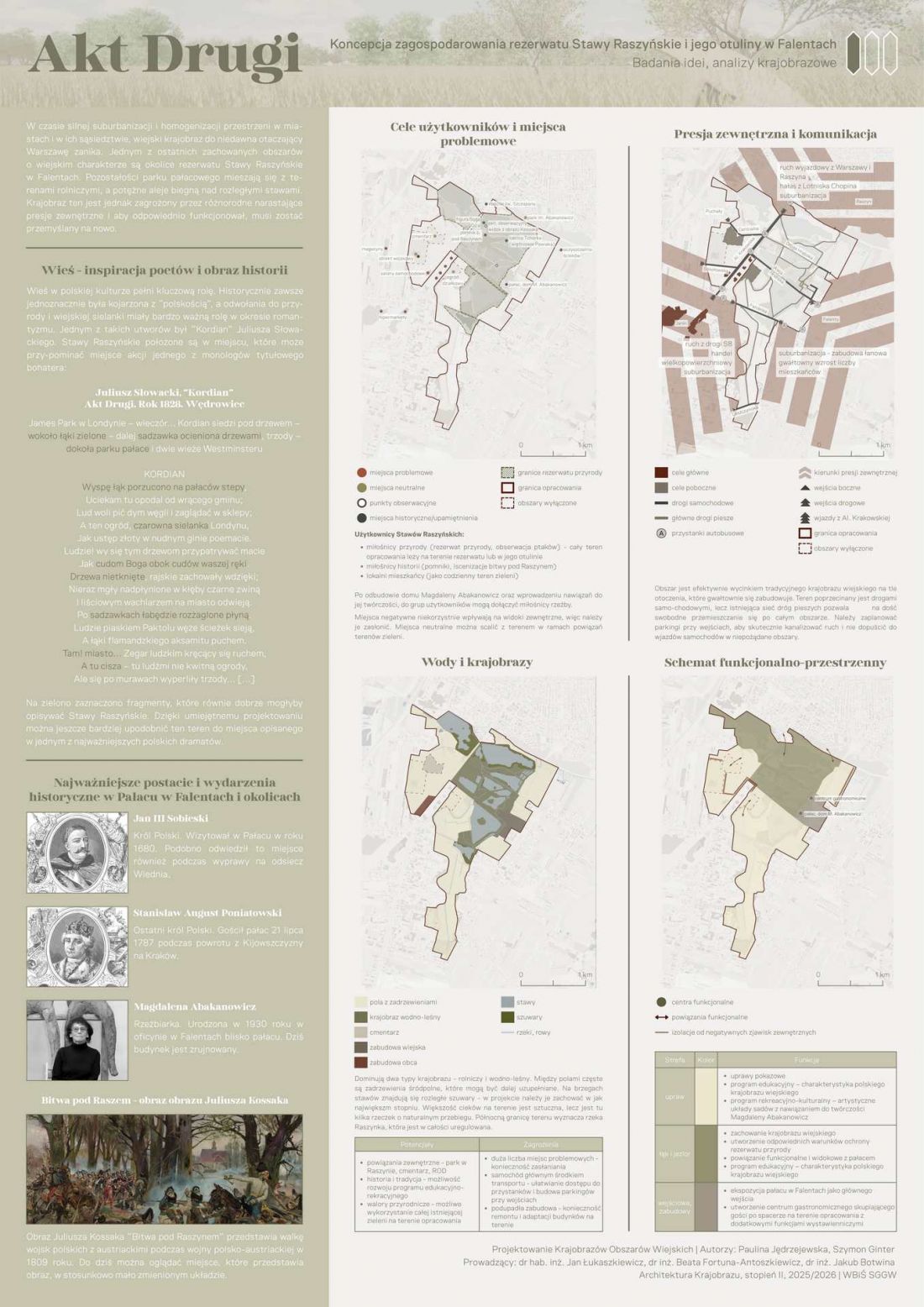
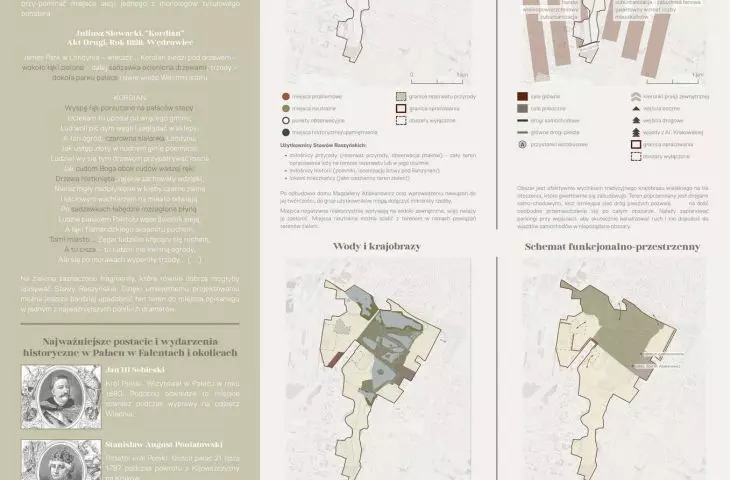
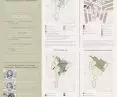
Analysis
© Paulina Jędrzejewska, Szymon Ginter
The Vanishing Village
The areas surrounding Warsaw have been undergoing intense suburbanization for years. The expanding metropolis is gradually swallowing up the former rural landscapes, replacing them with repetitive residential, commercial, and transportation developments. As a result, the area is losing its local identity.
One of the places where the rural character remains clearly visible is the area surrounding the Stawy Raszyńskie Nature Reserve in Falenty. It is here that the project’s authors saw an opportunity to create a space that would not be yet another area succumbing to urbanization pressures, but would instead become an enclave of landscape, history, and nature.
The project is based on the premise that the rural landscape is not merely a remnant of how the land was once used. It is a vessel of memory, tradition, and culture, and its protection can serve as a means of preserving part of the local identity.
The Romantic Landscape as Inspiration
The starting point for the concept was Polish Romantic literature, particularly Juliusz Słowacki’s *Kordian*. In the monologue opening the second act, the title character experiences peace and a sense of being cut off from the urban hustle and bustle as he observes trees, clearings, and lakes.
The project’s creators interpret this scene as an expression of longing for the native landscape. The Romantic idealization of the Polish countryside was, after all, one of the key ways of building national identity. The countryside became a space of memory, rootedness, and values that could be passed on to future generations through the landscape, symbols, and stories.
This is precisely why “Act Two” is not merely a land-use plan. It is an attempt to translate cultural memory into a contemporary space where history can be experienced through engagement with the landscape.
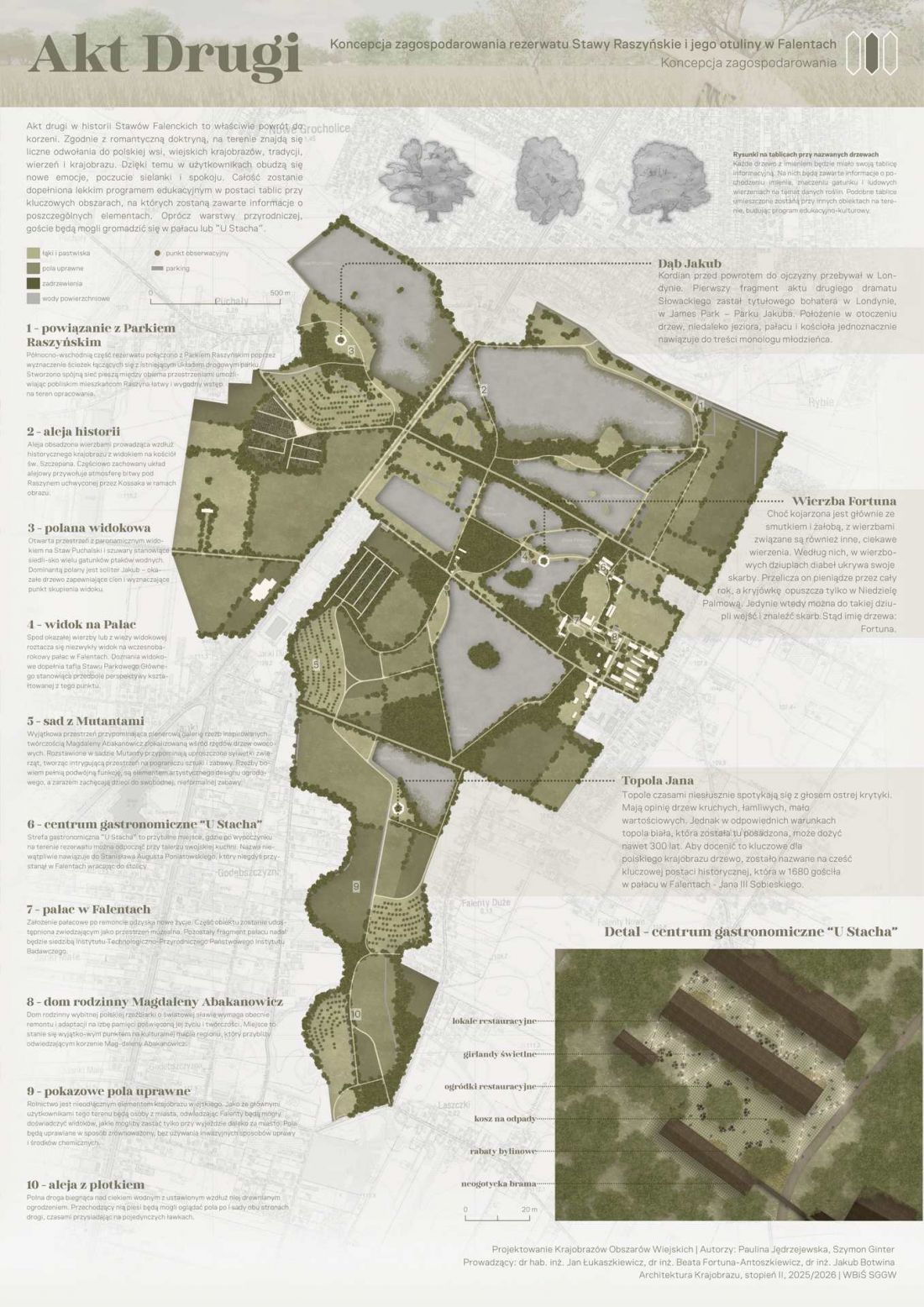
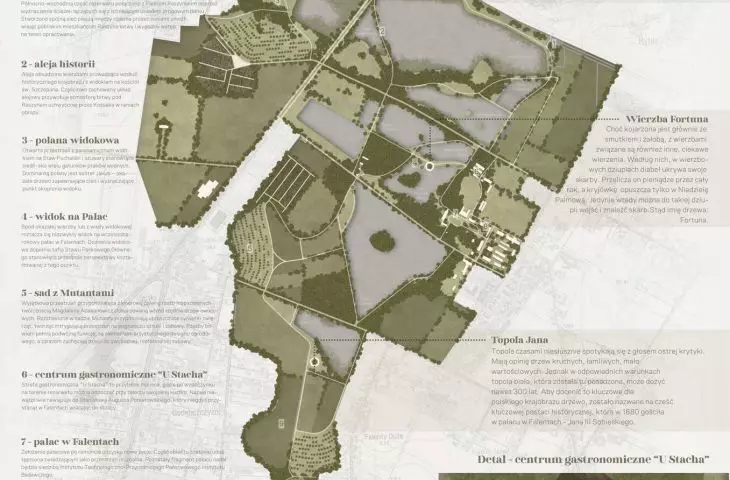
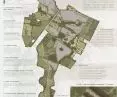
plan and detail
© Paulina Jędrzejewska, Szymon Ginter
Falenty—a place of many stories
Falenty and the area around the Raszyńskie Ponds have an exceptionally rich history. Nearby stands a historic palace that once hosted, among others, Jan III Sobieski and Stanisław August Poniatowski. The ruins of a house associated with the famous sculptor Magdalena Abakanowicz have also been preserved in the vicinity.
It is also a site linked to the history of the Battle of Raszyn, immortalized in a painting by Juliusz Kossak. One of the site’s attractions is the opportunity to find, within the actual landscape, a view recognizable from the painting.
At the same time, part of the area is designated as a nature reserve. The designers therefore had to balance making the area accessible to visitors with the need to protect existing ecosystems. Instead of dispersing foot traffic throughout the entire area, the proposal was to concentrate recreational activities in selected locations so that human presence would not disrupt the reserve’s functioning.
Three Trees, Three Stories
The central theme of the project is three tree species—the oak, the willow, and the poplar. Each tells a different story connected to the Polish landscape and culture.
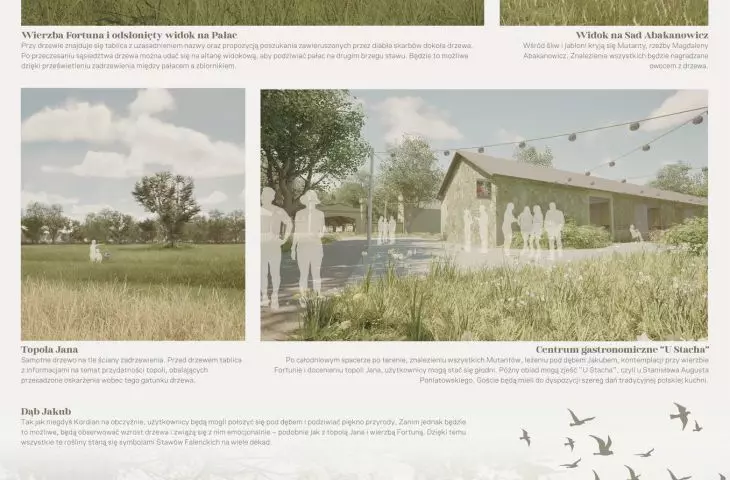
The oak is a direct reference to Kordian’s monologue. The willow evokes folk symbolism, beliefs, and culturally rooted imagery associated with the native landscape. The poplar, on the other hand, reminds us of the presence of this species in the Polish landscape and addresses the contemporary perception of plants, which does not always reflect their true natural and cultural value.
The trees are therefore not merely elements of the composition. They become vehicles for stories, and their significance is further emphasized by the names given to them, which allude to historical figures and the functions performed by the plants.
Landscape as a Set Design
The project’s name— “Act Two” —is no coincidence. The Falenty area is treated as the next chapter in the history of the place. The existing landscape becomes a stage where contemporary recreational functions intersect with memory, nature, and culture.
The project aims to preserve the characteristic open glades and ponds, surrounded by both dense and sparse groups of trees. This approach to shaping the space is intended to reinforce the sense of idyll and tranquility, which constitute one of the most important elements of the project’s concept.
The rural character is also emphasized by demonstration crops and orchards, designed as land art interpretations of the traditional agricultural landscape. However, they are not a reconstruction of the old village. Instead, they draw on its characteristic elements and transform them into a modern language of landscape design.
recreation that does not compete with nature
One of the most important principles of “Act Two” is to arrange the functions in such a way that recreation does not come at the expense of the site’s natural values.
Properly routed paths, observation points, and gathering areas allow for control over how the space is used. The program also features Magdalena Abakanowicz’s “Mutants, ” which enrich the landscape experience with an element of art.
It is important to create a variety of ways to spend time here. Visitors can explore the area on foot, observe nature, relax in the clearings, learn about the flora, or experience art. After spending the whole day there, visitors can stop by the “U Stacha” dining center, which will serve traditional Polish dishes.
The City Needs the Countryside
Underlying the project is a broader question about the relationship between the city and the countryside. The city cannot function without the countryside —not only because of food production or economic interdependence, but also because of social and cultural ties.
The paradox is that city dwellers are increasingly seeking peace and quiet, contact with nature, and relaxation in the countryside, while at the same time contributing to the disappearance of that landscape through suburbanization. New housing developments, commercial buildings, and infrastructure are gradually altering the character of areas that were meant to be an escape from urban chaos.
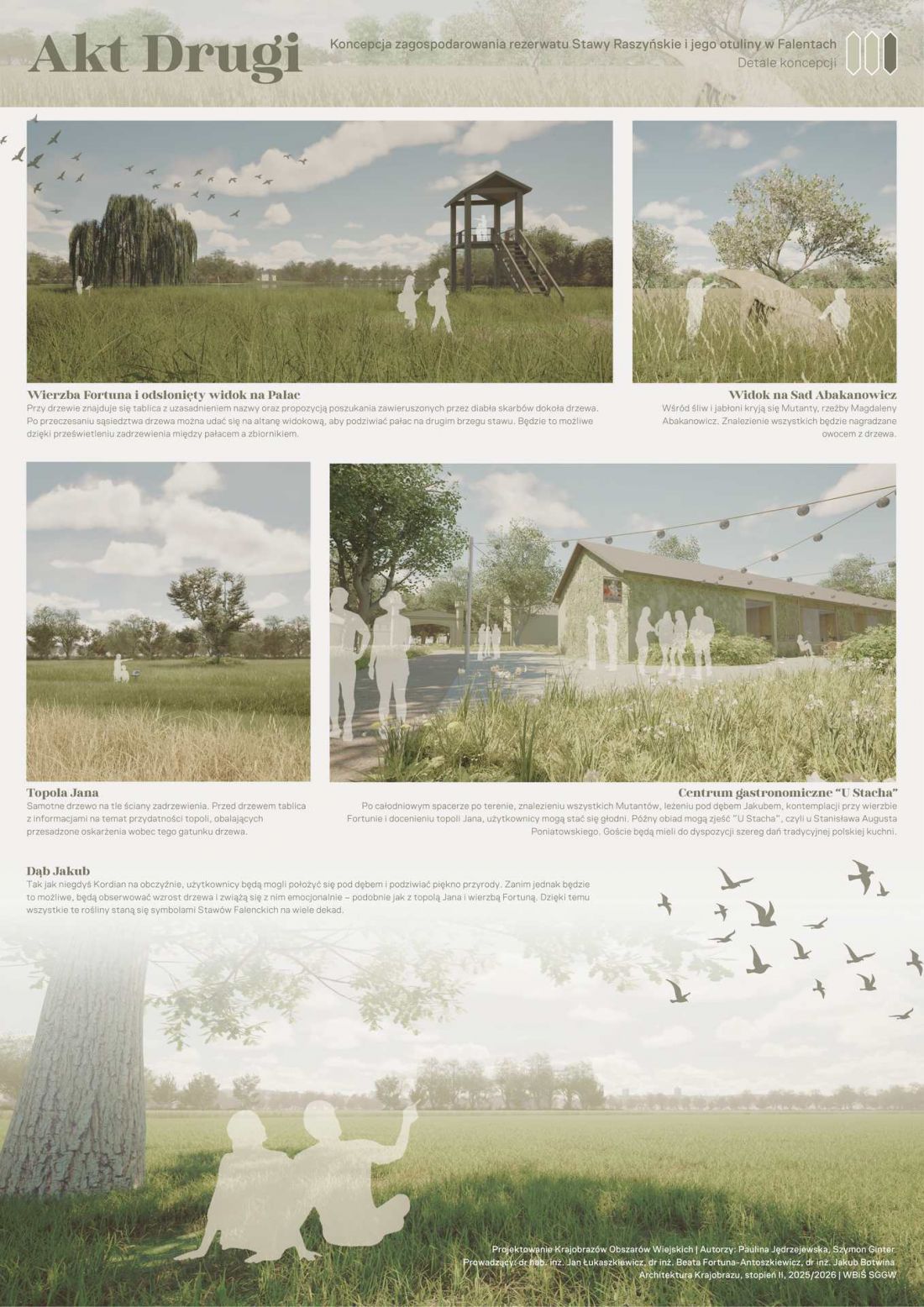
visualizations
© Paulina Jędrzejewska, Szymon Ginter
“Act Two” attempts to reverse this process. Instead of treating the rural landscape as an empty space awaiting development, the project proposes viewing it as an asset that should be preserved and developed in a way that meets contemporary needs.
The project by Szymon Ginter and Paulina Jędrzejewska demonstrates that landscape architecture can serve as a tool for telling the story of a place. Trees, ponds, clearings, orchards, works of art, and historical traces together create a space where the landscape becomes a vessel of memory.
In an era of advancing suburbanization, this perspective takes on particular significance. Preserving the rural character does not have to mean giving up the use of the land. It can mean creating a space where nature, recreation, and history remain in balance with one another.